Golmud was surreal in the most disappointing of ways. We arrived at 4:45 a.m. China's transportation system is miraculously, and magically, designed so that no matter what the distance to one's destination, and no matter what mode of transportation is used, the arrival time is always just before dawn.
We spilled out of the over-night bus and stood at a dark intersection just a block up from the massive train station. It stood there silent and empty.
One Chinese man who spoke good English asked us where we were headed as we gathered our bags from underneath the bus. We said that we were going to find a hotel here in Golmud, but were not yet decided on one.
He looked surprised and asked, "You are not going to Lhasa?"
"Uh, no, not yet. Hopefully, next week."
"Alright. Well, good luck." He waved his hand as he pulled his bag (on rollers) in the direction of the train station.
It was at this moment that I realized the ban on travel permits to Tibet applied only to foreigners.
Tom and I found a taxi and showed him, in Chinese, the hotel we wanted him to take us to. We piled in and we were off. The first hotel we went to said they were full, although the large parking lot was completely empty. The next two hotels also said they were full despite appearing totally abandoned. By the time we found a hotel that was willing to give us a room, the sun was rising.
Golmud, at sunrise, is reminiscent of something from a science fiction movie: it is perfectly flat, the streets are flawlessly straight, and the blocks are all precisely the same length. Even the buildings are all the same height and shape. It has the feeling that it was entirely built before anyone actually lived there, possibly even dropped there from a prefab factory. Eerie.
We got our room and slept until noon. I was the first to wake.
"I'll go scout around, you sleep," I said. Tom was not about to get out of bed.
We needed to find a way to get our permits and find a couple to join our Tibet tour while in Golmud. I walked for a good thirty minutes in a counter-clockwise circle. I found an internet room, a couple of noodle restaurants, and a handful of hair salons. All of the other places were strictly industrial.
Golmud is a mining town, and for all intents and purposes, it is perfect for what it is. What WE needed it to be, on the other hand, was something else.
Via the internet, we found the location of the two tourist offices in Golmud. Either of these places are authorized to arrange tours into Tibet.
We took a taxi to the first one and found a man sitting behind a desk smoking cigarettes and listening to the radio. Once he saw us, he motioned for us to sit down and made a telephone call. After ten minutes, a young woman entered and informed us that the office was "closed" until October 9th; the other tourist office would also be closed until that date.
However, she was amiable and made a few phone calls for us. She told us that the passport office was open and that they were able to make arrangements as well. She wrote down the address for us and we went to get a taxi. This was another instance which confirmed my belief in the lack of efficiency of taxi drivers in China.
The man had an address, written in his mother tongue, in his hand and he still could not find where we wanted to go.
He eventually dropped us off in the area he thought it was and drove off. We showed the address to store clerks on every corner until we finally found one who pointed us in the right direction. By the time we arrived at our destination, it was closed. The man in the shop next door said it would be closed the rest of the week, until October 9th.
The frustration that I felt at this time was nearing its pinnacle.
I went and got my hair cut. That's right. I got my hair cut in Golmud, middle-of-@*!&$#@!-nowhere, China.
Thomas and I had some serious deliberation to attend to. Contrary to what I was told to believe back in Cheng Du, it would not be possible to start the permit application before October 9th. Our understanding at that time was that travelers would be allowed to go on the 9th or after. This was not true. The process would not be allowed to start until the 9th; therefore, the soonest anyone would be going to Tibet would be the 13th.
The options were: 1) stay in Golmud for 5-8 days and try to find tour partners via the internet or 2) get the train back to Cheng Du where most of the Tibet travelers meet to form their tour groups. For me the decision was simple. Cheng Du. It didn't take too much discussion to get Thomas to agree.
That night we were on a train back to where my China adventure had originally started, and this time....we were going to go to Tibet.
Sunday, November 29, 2009

Monday, November 23, 2009
Dunhuang, Microlighting and The Jedi Mind Trick


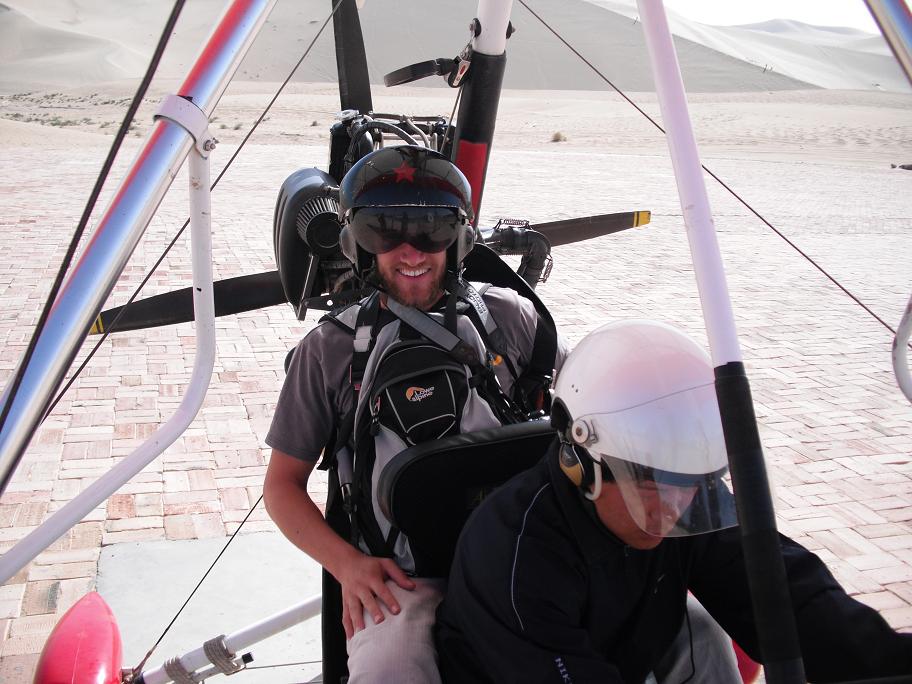


Upon arrival in Dunhuang, it was quite easy for us to find a nice hostel tucked into the trees beside the edge of the desert. And the Lonely Planet was absolutely correct about the town being convenient for foreigners. But, I started ahead of the real story...
Early in the morning, before our arrival, I questioned Tom about his visa status. I knew that China mostly grants one month tourist visas. He had been traveling from Beijing for a couple weeks before I flew into Cheng Du and we had already spent about two weeks together. So, I casually asked him while we were both half awake on the sleep-filled train, "When does your visa expire?" This question seemed to rouse his curiosity. He sat up and pulled his passport from his bag.
"It expired yesterday," was his reply. Both of us were slightly nervous about the implications of such a situation. The resolution was to first find accommodation and then find the passport/tourist office in Dunhuang as soon as possible.
When we arrived at the hostel, they would not give us a room because of the expired visa. Luckily, it was midday. We asked the man at the desk to call us a taxi to take us directly to the passport/visa office.
As the taxi pulled into the Dunhuang Police Station, I saw the expression on Tom's face change from inconvenience and disgust to one of uncertainty and slight terror. The Chinese Police are not the ideal type for understanding misunderstandings.
We walked into the lobby and there were three police officers lounging around in their socks, chain-smoking cigarettes, and watching the replays of the holiday celebration in Tiananmen Square from the day before. There were trucks with nuclear rockets and tanks in formation and millions cheering on the screen.
One of the men told us to sit down and wait. He made a phone call and then resumed his position on the sofa next to the massive ashtray. About fifteen minutes later a woman in a pantsuit arrived and escorted us to an adjacent office.
To make a long story short, Tom convinced me of a theory that I've maintained since childhood: the Jedi mind trick is not a fictitious invention.
At first, the woman said it would be no problem to get a month visa extension. It was printed out on the spot and pasted in his passport. Then she came to the subject of price. Tom's visa extension would be 160 yuan (approx. $26 U.S. dollars). She then proceeded to tell him that he was two days past his expiration date. Each day came with a 500 yuan penalty. Thus, she concluded that he owed her 1,160 yuan.
It was at this moment that I actually witnessed the Jedi mind trick for the first time in my adult life. Tom, being the master price negotiator that he his, proceeded to tell her that the day before was a holiday and that he had no way of obtaining his extension. Therefore, it should only be a one-day penalty. She agreed.
"You're right, it's only a one-day penalty," she repeated after Thomas.
"And I was on an overnight train, as well." Tom produced our post-midnight train stub from Shandan and presented it to her. "I could not do until now. So, there should be no penalty."
"Okay, there is no penalty," she again repeated the words from his mouth.
Tom paid her the 160 yuan and we walked out into the street.
As soon as we were around the corner I burst into belly-full laughter fits. Tom had gone from scared pale 60 minutes earlier to bartering with the woman about the price of his extension. And he had won.
He threw up his arms in a manner that spelled V-I-C-T-O-R-Y. I told him that we were going to get the most expensive western-style meal we could find and that it would be on him. There were no objections.
We spent three days in Dunhuang. It truly is a lovely town. The streets are tree-lined, well-paved, and the girls are slave to fashion (as in much larger cities around Asia).
We went micro lighting, which is quite possibly the single scariest thing I have ever done, yet also one of the most exhilarating. It's basically a boxcar with a fan that is tied to the bottom side of a hang glider. It takes off completely vertical and loves to wobble (the only thing holding you in is a car seatbelt).
We also saw The Old City, an ages-old dynasty fort that has been turned into a quasi-amusement park much in the same vein of Old Tucson (for those who are familiar).
All in all, Dunhuang was a lovely place. We met some nice Canadians at the hostel and even had a barbecue with some of the locals.
We exited by sleeper bus to Golmud. The next week needed to have us preparing our Tibet permits for the earliest possible departure (according to the sign mentioned earlier, October 9th).
Despite all of the excitement, we were getting antsy for Lhasa and, of course, Everest.
Link to short microlighting clip on Youtube:
http://www.youtube.com/watch?v=ENmRtKdnvV4
Sunday, November 22, 2009
Shandan, Western China


The morning that saw Gunther and Yong Ha return east also saw Tom and I getting on a bus to Shandan. This was the next stop on our path that would eventually lead to Golmud. When we booked the ticket, I understood that it was only a 200km journey. This was one of the shorter distances I had covered at once in China and I expected it to be rather uneventful.
200km is only 126 miles. Even in a bus going a conservative 60km/h it shouldn't take more than three and half hours. This bus ride was about to challenge everything I thought I understood about distance equalling rate times time.
First of all, I believed that a cross-country bus with approx. 30 seats wouldn't be able, or willing, to transport more than 40 people. This was my first misconception. After the aisles and the steps at the front door were properly covered with bodies, we set off.
The road was dirt most of the way. Vertical. Winding. Desert mountains. Cliffsides just inches away from the tires. Sheep in the road.
Six hours later, we arrived in Shandan. Tom and I had flirted with the idea of going into Kyrgyzstan and Tajikistan. Shandan looked like what my imagination told me either of those two places would look like. It was mostly dirt and dust. Cars filled the streets, cars that appeared to have been magically lifted from the science fiction magazines of the forties and fifties. There were a lot of buildings, but most were vacant, hollow, ghost-like. Again, the men in the street seemed to have been standing/sitting there for decades. They were withered, wind-beaten, and smiling at us with no teeth.
We immediately took a taxi to the train station in search of the earliest train to the next "town." Luckily, there was a post-midnight train to Dunhuang. Dunhuang, according to the Lonely Planet, was "tourist" friendly. We bought the tickets and hiked the 4km back into town (the taxi having deserted us).
Instinct told us to find the restaurant with the most patrons and go in prepared to point and smile as charmingly as possible. We ate noodles with some meat-such substance and pantomimed that we would like to find an internet room. One woman amazingly understood what we wanted and pointed us in the right direction down the road. We had eight hours to kill.
A few blocks from the internet room, we were accosted by a high school English teacher and his apparently "star" student (her English was more discernible than his). She was sweet, if not disastrously naive. She confided in me that she wanted to study journalism in university. I decided it was best not to point out why being a journalist in China may not be the most desirable position for a girl with such potential. Then, once she found out that we were headed to Lhasa, she very proudly boasted that her brother was a soldier living in Lhasa. Again, I decided not to try to explain that he was undoubtedly suppressing religion and culture. She was painfully sweet and thoughtful. She showed us to the internet room, arranged for us to pay for the time we wanted (eight hours), and even sat with us while we checked our email to make sure that we were able to use the computers properly.
I mostly streamed movies and drank Sprite for the duration of the afternoon/evening. I watched "Bronson," an ultra-violent film loosely based on the story of Britain's most violent convict. The performance by the lead actor, Tom Hardy, was astounding. He will be a rather big name in years to come. I also watched "District 9" which I believe is the best science fiction movie I've seen since "Primer."
However,...
It was the big holiday. 60 years of Chinese communism. The shouts and fireworks from the town square could be heard. Hordes of cheers. I asked Tom if he wanted to go and check it out. His answer was a stout, "not a chance."
By 11:30 p.m. when Tom and I were hiking our way back to the train station, the streets were deserted and quiet. We passed by the town square which was completely covered in celebration debris. I bought a big bottle of beer upon entering the station. As I drank it on the platform waiting for the train, I stared at the stars blanketing the sky. Little did I know that the skies were only to get more and more inspiring as my journey continued.
I also looked at the few silhouettes of people standing in the late-night/early morning dust on the platform as the train arrived. We piled into our car and promptly fell asleep among the Chinese sprawled all over the seats in various states of undress.
We would be in Dunhuang by the late morning and onto another stage of spelunking the depths of the Chinese West.
Good bye to Gunther and Yong Ha...
After returning to our hotel after the desert, Gunther and Yong Ha decided that they should start heading back to Beijing. Gunther's trip was running out of time (he never intended to go into Tibet). Yong Ha's girlfriend, an extremely patient girl who had been waiting for Yong Ha in Seoul while he traveled for an undetermined amount of time, had let him know that she had fallen ill. He told us that he had been traveling for eight-plus months and that he didn't know how much longer her patience would last. He was more than willing to give up Tibet in order to go and be with her. However, he told Tom and me that he would try to meet us in Kathmandu in two/three weeks time, if able.
So, it would be our last night together. The four of us had been traveling together for at least 12 days by this point (and encountered/endured situations that test the best in one's character). "Bonding" doesn't fully describe such times. It was clear that we would stay up as late as possible, drink beer, and play the last few hands of a marathon game of "shithead" that had begun the night we all met.
The night went as planned. A lot of laughs and Gunther being "shithead," "tete de merte" (French), "ddong muh ree" (Korean), until he gets a chance to redeem himself.
The next morning Tom and I said good-bye to Gunther and Yong Ha. We decided to continue our journey into the nether regions of Western China and wait for the Tibet suspension to end in a town called Golmud. Golmud is the last stop on the train before it heads into Tibet. The idea here being that we could avoid another 30+ hour train ride and see more of China while doing it.
It promised to be interesting, if nothing else.
So, it would be our last night together. The four of us had been traveling together for at least 12 days by this point (and encountered/endured situations that test the best in one's character). "Bonding" doesn't fully describe such times. It was clear that we would stay up as late as possible, drink beer, and play the last few hands of a marathon game of "shithead" that had begun the night we all met.
The night went as planned. A lot of laughs and Gunther being "shithead," "tete de merte" (French), "ddong muh ree" (Korean), until he gets a chance to redeem himself.
The next morning Tom and I said good-bye to Gunther and Yong Ha. We decided to continue our journey into the nether regions of Western China and wait for the Tibet suspension to end in a town called Golmud. Golmud is the last stop on the train before it heads into Tibet. The idea here being that we could avoid another 30+ hour train ride and see more of China while doing it.
It promised to be interesting, if nothing else.
Tuesday, November 17, 2009
Badain Jaran Desert (Inner Mongolia)


The morning began with an hour-long jeep ride to where the dunes begin. It was nine in the morning, but still quite dark. We drove through a massive parking lot in the middle of nowhere; a few dozen desert-blazing jeeps were preparing to go out for the day. They were each fully-equipped with roll bars and a pair of "oh-shit" straps for every seat. Our jeep dropped us off at a lone tent two hundred yards out into the sand where our guide apparently set up the night before for us and had to camp out in wait. Once he saw us pile out of the jeep, he emerged from the tent and began to load up four, massive, beautiful-looking camels with the gear we would be needing for the journey.
About a hundred yards behind the tent was a 100 foot sand dune that blocked our view of the desert, so we hiked to the top of it while the guide finished preparing the camels. The view from the other side was unlike anything I'd ever seen. It was a veritable ocean of sand. As far as the eye could see there were rolling dunes with sporadic patches of small green shrubs. The shrubs are able to flourish due to what I was told was a series of underground rivers (this also makes it possible for there to exist multiple little fresh and salt water pools in random areas of the desert).
Each of us picked the camel we wanted to ride and proceeded to give them names. I thought it was only natural to give them feminine names; however, Tom named his "Lumpy." Mine was "Gertrude."
We climbed onto our camels and were on our way. Camels are supposedly more difficult to control than horses, so each of our camels had a lead rope attached to the camel in front, with our guide in the lead (on foot!).
The first hour was difficult to say the least. Our guide stuck near to the jeep path and every time a desert jeep caming roaring past, it spooked our entire fleet. Every time the camels would stick their heads in the air and sidestep nervously about 15 feet. The dunes were soft and steep and we went straight over them. Camels ae amazing creatures.
The giddy feeling initially felt upon climbing atop a camel ends quickly, however. After about forty minutes, I could no longer feel my ass or legs. Constantly shifting in between two hairy humps doesn't help either; it was impossible to get comfortable. I motioned to the guide that I would like to get off and walk (he didn't speak any English). He understood and very simply motioned for me to dismount with a wave of his hand. Dismounting from a seven foot high seat with packs tied on both sides of the animal is not the easiest thing I have done. On my first attempt, I landed hard on all fours in the sand...but, overall, walking across the sand dunes was enjoyable.
We all got off our camels and trekked across the sea of sand dunes. We all got to laughing about our guide who seemed to be inhuman. He maintained a slow, steady gait and blankly stared at the shifting horizon. His inital nickname became "Terminator."
After a few hours of walking, Tom began to question where we might be camping for the night. Every time we asked the guide, he would just nod and point straight at the horizon. The agreement with the tour agency had been for a three hour camel journey into the desert, camp for the night, and return the following morning. This was not what the guide had heard and he was committed to a full day of hiking.
After seven hours of hiking deep into the dunes of the Badain Jaran Desert, we finally reached our destination. It was five in the evening and we were all exhausted. We had about forty minutes until pitch dark. We pitched our tent and collected bushes for a fire in record time.
We spent the night beside a salt pond and underneath the stars. I think we were all asleep by nine.
The next morning our guide was up with the sun and ready for another seven hour hike. I was freshly rested, newly motivated and ready for it.
The views were breathtaking, but the journey felt like an enternity.
Yong Ha spent the entire day on the back of a camel. That is a feat which I cannot explain. Myself, I hiked the whole way with the guide, whose nickname changed from "Terminator" to "Terminator X" to "T. Rex." He was unstoppable and most impressive.
All said, the journey into the desert was well worth doing, but two whole days of hiking Chinese sand dunes spells disaster for undertrained calves and feet used to comfortable shoes. I believe I lost two kilos in those two days. And, sadly, foot massages in China do not compare, even remotely in terms of quality, to those in Thailand.
It dawned on me as we returned that we were the only ones in the entire desert on camels; everyone else took jeeps.
Sunday, November 15, 2009
The Journey to Badain Jaran Desert


Our mission was simple: ride a camel across a China desert (Badain Jaran). "This desert is home to the tallest stationary dunes on Earth. Some of the dunes reach a height of 500 meters (1,600 ft.)" (Wikipedia).
We booked a "soft-sleeper" for four on the 29-hour train from Cheng Du to Yinchuan, departing at 10 p.m. Once on the train, we had a beer, spoke excitedly about what unpredictable experiences awaited us, and went to sleep.
The train ride, for being the longest train ride I had ever encountered, went more smoothly than I anticipated (not counting having to use a squat toilet on a constantly rocking train). The first many hours we slept. After waking, we had breakfast, played more cards (Gunther was "shithead" for a long time on this trip), had a few beers, and interacted with an overly-energetic Chinese girl who kept running up and down the aisle of our car. She couldn't have been more than 10 years old and it was later discovered, by Thomas, that her parents were feeding her watered-down beer. Although this came as quite a shock to the lot of us, it went quickly ignored and Thomas mysteriously disappeared from the cabin.
Thirty minutes later, Thomas returned saying that he had ventured a few cars down and found a group of university choir students that were eager to practice their English. So, we packed up (beer and cards) and went to socialize with the locals.
They were a merry bunch: constantly singing songs (with the natural performers' usual and unequaled hunger for attention), flirting with us, and giving an endless supply of high fives and compliments. I was quite impressed that they sang in so many languages. Some of the men knew Italian arias. About six of them got all of the way through "Arirang" (a traditional Korean song). Although their education was fascinating to me, the high-level of energy proved too much for me to endure on the narrow and constricting train. I said good-bye as politely as possible and returned to my sleeper for an afternoon nap. Shortly after I left, Gunther was beaten in an arm-wrestling match with one of the seemingly pre-pubescent young choir boys. This was a source for much taunting throughout the duration of our travels together and I promised to include the fact here.
After another night of sleep, the train reached Yinchuan at four in the morning.
Upon arrival in Yinchuan, we had arrived at a decision as to which hotel we wanted to stay at (based on the options given in the Lonely Planet). It was not difficult to get a taxi at the station.
TANGENT WARNING!!!!
However, I must regress here for a moment to lament some truths about the current taxi driving situation in China. First of all, a Chinese taxi driver will have no problem picking you up and driving you even if he has no idea where you are going. Secondly, taxi drivers often are not familiar with the towns in which they are driving (and presumably living!). Thirdly, they expect payment based on their time, not on whether or not they get you to your requested destination. On more than one occasion, I sat in a taxi for up to five-ten minutes before realizing that the driver had no clue where he was or where he was going. Drivers would often stop to ask other drivers where certain locations were to be found. More than once, a driver would stop the car and get out to go and talk to men and women standing on street corners. There were even instances when I had a local map, in Chinese!, and was able to point where I wanted to go....confusion was still victorious. And, sometimes, after any of number of minutes of driving, the driver would sometimes give up, drop you off on a corner where YOU had no idea where you were and still have the gumption to demand payment. Such moments were always welcome to vent some pent-up traveler steam.
This was the experience on that very early morning upon entering Yinchuan. Three taxis, four hotels (all mysteriously booked in a town that looked empty), and well over forty minutes of sitting on the sidewalk (while a slew of drivers confusedly ranted at one another) later, we finally found a driver who seemed to take a little pride in his work. We got a room and crashed hard.
Yinchuan was about as happening a city as we were to see for many a moon. It had a fairly-good-size outdoor mall, tree-lined streets, and even a visiting American, semi-pro basketball team traveling through town. They were treated like celebrities; their height was impressive, especially in Yinchuan. Every Chinese person on the street stopped them to take a picture on their cell phones (I witnessed this for a good thirty minutes).
The town of our final destination for camel-trekking is called Alashan Youqi. For the better part of the afternoon, we spent an eternity traveling from bus station to train station, back to bus station and then back to train station and then propositioning taxi drivers and private cars, in an attempt to get to where we wanted to go. Thomas was convinced we could hire a private car for 200 yuan. Anything higher than that, in his guesstimation, was highway robbery (this was later discovered to be a major error on our part, Alashan Youqi being over 700 km away). So, we continued to hustle the shit out of the locals. The haggling that ensued, in retrospect, is insanely comical. They must have thought us to be mildly, if not completely, mentally impaired.
At one point, we had a female driver who piled all of us and our bags into her car and started down the road. After she got out, twice, to ask others where this place was that we wanted to go, she nicely told us that it wasn't possible (by a negatively-inspired flailing of her hands).
Our hopes of getting to Alashan Youqi that evening were shattered. We decided to stay another night in Yinchuan. The next day we would take a bus to Alashan Douqi (not Alashan Youqi), from there it would be another night stay because the next bus from Douqi to Youqi only leaves at 7 a.m. The journey from Douqi to Youqi is 500 km (a fact unbeknownst to us at the time, as previously stated).
In Alashan Douqi, NOTHING DOES EXIST. Sartre would have loved it. The streets were barren. The tallest building in sight was two stories. A layer of dust covered everything as though movement was scarce. The few people sitting on the sidewalk (all smiling with missing teeth) looked as if they'd been sitting there for years.
We ate a massive plate of mutton (Gunther pictured above in his normal/primal state) and spicy noodle soup with dumplings. The food was amazing, but we were all very excited to leave Alashan Douqi as quickly as possible.
The bus the next morning was brutal. It was over-packed and sweaty sweaty hot. Sweaty sweaty highway travel in China is very similar to sweaty sweaty highway travel in the Western United States, actually.
Just as it seemed that we would never arrive (10-hour, cramped bus journey later), the bus pulled into Alashan Youqi. Everyone rejoice!!!!! The bus station was a closed building with eight people standing outside. In every direction, sand as far as the eye could see.
As soon as we stepped from the bus, a girl handed me a flyer for a desert jeep tour and Tom set to work. Through an impressive, and lengthy, performance, Tom was able to communicate that we wanted a camel tour instead of a jeep tour. That was the easy part, then, as always, came the issue of price. This is where Tom really likes to shine; the man should have been born in a Turkish silk bazaar. Every time he gets a chance to haggle, he gets as giddy as a boy with a toy. By the time he was finished, he had a crowd around him (some cheering/some jeering).
Anyway, we found a room and booked our camel trip for the following day. It was agreed that we would take an hour car ride out to the desert, from there we would have a three-hour camel ride to a campsite, stay the night, and return the following day in the same manner as we arrived.
This promised to be a lot of fun.
Monday, November 2, 2009
"Tibet is closed...again"
When we returned from Qingcheng Houshan to Cheng Du, we found a sign in Sim's lobby: Tibet is closed...again.
The Chinese government is not issuing travel permits to Tibet until Oct. 9th.
No one had to say a word, but it was the talk of the town. China was preparing for its 60th anniversary holiday. The Chinese flags were out on every flagpole, in front of every shop and flapping alongside each taxi.
It would be bad for foreigners to be in Tibet in case any Tibetans felt like protesting the fact that they have been occupied and oppressed by the Chinese for the past fifty years.
Gunther, Yong Ha, Tom and I sat and drank beer on the veranda.
"I could have stayed in Thailand for another two weeks if I had known this was going to happen?" I, unthoughtfully, said.
"How can they close a whole country?" Yong Ha asked (his English is surprisingly good on occasion).
"It's not its own country, according to the Chinese." Tom was ceaselessly flipping through the Lonely Planet for options.
"Look at those two over there. We should go to a club tonight. Ladies, ladies." Gunther mostly just smiled and sipped beer.
A German guy we had been eating with regularly had already paid for his Tibet tour would now not be allowed to go.
"This is b*llsh*t. I'm just going to fly to Kathmandu. Maybe I'll see you guys in India." he said. (He later gave me a pair of long pants that he wouldn't be needing anymore and some socks....nice guy)
Somber moments....and then...
"Up north, in Inner Mongolia, they have the fourth largest desert in the world, camel-trekking, dune buggies, microlighting, 700 meter sand dunes!" Tom had found the section of the Lonely Planet that he had been searching for.
"I'm in." I said without a thought. "We have two weeks to kill."
It didn't require much discussion to get Gunther and Yong Ha to sign on. Yet, we lost Mark...he had to return to Beijing.
The Chinese government is not issuing travel permits to Tibet until Oct. 9th.
No one had to say a word, but it was the talk of the town. China was preparing for its 60th anniversary holiday. The Chinese flags were out on every flagpole, in front of every shop and flapping alongside each taxi.
It would be bad for foreigners to be in Tibet in case any Tibetans felt like protesting the fact that they have been occupied and oppressed by the Chinese for the past fifty years.
Gunther, Yong Ha, Tom and I sat and drank beer on the veranda.
"I could have stayed in Thailand for another two weeks if I had known this was going to happen?" I, unthoughtfully, said.
"How can they close a whole country?" Yong Ha asked (his English is surprisingly good on occasion).
"It's not its own country, according to the Chinese." Tom was ceaselessly flipping through the Lonely Planet for options.
"Look at those two over there. We should go to a club tonight. Ladies, ladies." Gunther mostly just smiled and sipped beer.
A German guy we had been eating with regularly had already paid for his Tibet tour would now not be allowed to go.
"This is b*llsh*t. I'm just going to fly to Kathmandu. Maybe I'll see you guys in India." he said. (He later gave me a pair of long pants that he wouldn't be needing anymore and some socks....nice guy)
Somber moments....and then...
"Up north, in Inner Mongolia, they have the fourth largest desert in the world, camel-trekking, dune buggies, microlighting, 700 meter sand dunes!" Tom had found the section of the Lonely Planet that he had been searching for.
"I'm in." I said without a thought. "We have two weeks to kill."
It didn't require much discussion to get Gunther and Yong Ha to sign on. Yet, we lost Mark...he had to return to Beijing.
Subscribe to:
Posts (Atom)